
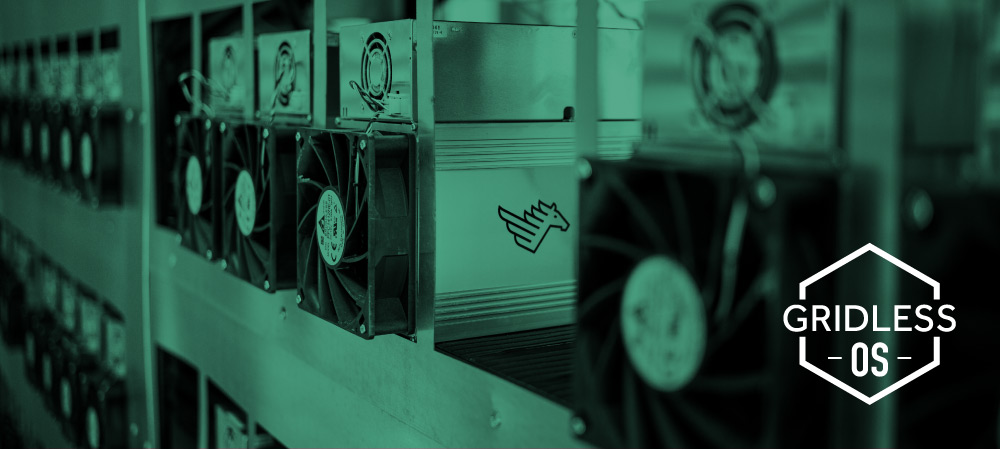
Gridless OS: Mining and Energy Management
It may not seem obvious at first that Bitcoin mining machines are difficult to manage well. The average air-cooled miner is the size of a shoe box, requires a power and ethernet connection, and doesn’t even have a power switch. A truly fit-for-purpose machine that you plug in and it starts making money. On the surface this seems the definition of simple.
The truth is that managing a few machines in your basement is not difficult. If you have the access and time to touch each machine every day and make sure that it is happy, mining is actually pretty easy. What makes mining difficult is when you attempt to do it at a bit larger scale. A hundred machines is significantly more complicated than a dozen and a thousand is exponentially more difficult than a hundred. Bitcoin mining is essentially an inverse economy of scale – at least in terms of complexity and human effort.
Thankfully, Bitcoin miners have had access to some great tools to improve the efficiency of managing large numbers of miners. The most well known of these, Foreman, has been an essential tool for us at getting Gridless off the ground. Foreman allows us to monitor, alert, track, and report on machines across multiple sites. The tool is well built, easy to use, and – if your objective is to just run your machines as efficiently and profitability as possible on a consistent energy supply – then it is the best turnkey option available.
If only things were that simple in Africa.

Our model of Bitcoin mining has us working with small independent power producers (IPP’s) to monetise their stranded, excess energy. We do this by providing them a revenue share of the money we earn from Bitcoin mining their excess electricity. While this revenue share is significantly better than the zero dollars they were paid for this excess energy previously, it is often less than what their customers pay for electricity. This means that for our model to work for the IPP we need to be able to ensure that their higher paying customers always get first access to available power and we only take the excess that no one else wants.
In the very early days, we used the Foreman scheduling feature to turn off some of our machines during peak hours of demand and then turn them back on during low periods of demand. This worked in a very rudimentary way, like hitting a digital light switch, but it was not at all an efficient use of the wasted power – we left quite a bit of unused energy on the table. Bitcoin mining is a game of operational efficiency and the higher the uptime with the lower the cost inputs the more likely a Bitcoin miner is to survive during tough economic cycles. We needed to maximize our uptime while not taking from the paying customers.
As people who had built both hardware and software companies it was pretty obvious to us that this was a problem that could be solved with some programming – and thus, Gridless OS was born.

In simple terms, Gridless OS monitors the conditions of the generation supply and the grid demand to determine how much excess energy is currently available. The system then turns miners on and off to always match the excess supply. This means that Gridless is able to monetise every possible unit of electricity without impacting the operation of the grid.
The primary features of GridlessOS:
- Monitors energy demand from our power partners customers (community, businesses, etc) via grid signals (e.g. frequency).
- Observes and responds to the energy supply with sensors installed on the provided power source – optimizing the use of available energy.
- An algorithm adjusts which ASICs go on/off depending on supply and demand, and paying attention to which ones have cycled up and been turned off most recently.
- Runs a dummy pool locally in case there is a loss of connectivity to ensure load stability.
- Manages our connectivity – we have to bond at least two internet connection services in order to not drop too many shares.
- Real time dashboards and alerts for ourselves and our power partners.
As time has gone on we’ve been able to significantly enhance the performance of Gridless OS and to incorporate a number of data instrumentations to give us an ability to react more quickly and more precisely. We are also able to optimize the performance of the machines based upon the available power so that we get the maximum hash rate for the given availability of energy and the machines at a given site. The tighter we get the response of the data center the better we can extract the maximum value from the wasted energy. The data instrumentation is also allowing us to visualize the performance of the energy sites and we have started providing the IPP with dashboard access on a level they have never had before. All of this is working together to not only make our Bitcoin mining operation more efficient but also to make the overall operation of the IPP more efficient.
As we look at the next phase of development on Gridless OS we are starting to explore a couple of different features that we believe will allow us even greater efficiency and control over the performance of energy+mining sites. One area we are exploring is the integration of a custom control board to give us more granular control over the performance of the machines. If this R&D effort proves out, we could very quickly get to a point where the data center begins replacing some of the physical infrastructure at a generation site to provide a more stable grid. Another area that we are exploring is the integration of AI and machine learning. There is a tremendous amount of data that we are now capturing on the performance of these IPP sites including their seasonal performance. We believe that we can use predictive analytics to know how to best optimize our sites based upon projected supply/demand. It is not inconceivable that Gridless OS will provide us with the ability to optimize the placement of our mining assets based upon weather and customer demand across various geographies.

A custom, ruggedized micro server runs everything
All of these development efforts add up to an ability to maximize performance, efficiency, and profitability even in standalone sites in remote parts of Africa. We are very excited to see where our development efforts in 2024 will take us and – as we rapidly expand our mining footprint this year – we are confident that there will be many new obstacles that require additional development and innovation to overcome. Although all of this effort is used to serve our own needs today, we are definitely thinking about what it will look like to provide access to Gridless OS to the other miners across the continent trying to tackle similar challenges. Who knows, maybe this home grown African technology stack will even make its way back into the data centers of miners in other continents.


