


We have a strange problem in the world right now. We’re short on compute and long on electricity. Those two things shouldn’t coexist, but they do – and the gap between them is where the next big infrastructure company gets built.
The AI boom is eating power like nothing we’ve ever seen. Data center demand is expected to more than double in the next few years. Meanwhile, clean electricity is literally being thrown away.
- California dumped 27 million MWh of solar in 2022 because the grid couldn’t absorb it.
- Britain tossed enough wind power to light 2 million homes.
- Texas clipped 5 TWh of clean generation because there wasn’t a wire to carry it.
- Europe spent a third of 2024 paying people to take its electricity.
And across Sub-Saharan Africa, half a billion people still don’t have basic power – even though the continent’s renewable potential dwarfs its demand many times over.
The energy and compute demand exists, there’s just a mismatch bridging the two.
What if we just moved the computers to the power?

The traditional grid was built like a 20th-century corporation: a few large, inflexible “salaried” power plants, long copper spines, and one-way flows. That worked fine for decades. But now the grid is flooded with millions of unpredictable “freelancers” – solar panels and wind turbines that only work when the sun is out and the wind is blowing. New transmission lines take a decade to permit. Solar farms get curtailed because there’s nowhere for the electrons to go. And cloud data centers are so far from end users that the latency kills real-time applications.
What our grid is missing is its gig economy: an army of on-demand, digital workers that can be summoned instantly to absorb excess energy, turning flexible demand into a grid-stabilizing asset.
The idea behind what I’m calling the Emergent Grid is simple: instead of moving megawatts to computers, move computers to megawatts.
Take modular, containerized compute – GPU clusters, bitcoin miners, storage – and bolt it directly onto sites that have surplus renewable power. Solar farms. Wind clusters. Mini-hydro plants. Geothermal wells. Wherever clean electrons are being wasted or stranded, put a compute load there that can soak them up.
Bitcoin mining proved this model works. Miners have been clustering rigs at waterfalls in Iceland, flare-gas sites in Texas, and offgrid hydro in rural Zambia for years. They showed that orphaned megawatts can be monetized by mobile compute. AI inference is the higher-margin, higher-growth successor – containerized GPU pods that follow the sun like nomadic data centers.
The Three Layers

Here’s how I think about the stack:
First, the energy layer. For a century, we’ve been shackled to centralized power generation, building our world around the grid. That has made countless energy-rich locations – sun-scorched deserts, wind-swept plains, powerful geothermal wells – financially unviable. Traditional project finance demands long-term power purchase agreements and a guaranteed buyer nearby. That strands trillions of dollars in potential energy. The Emergent Grid starts with small-to-medium renewable outposts at the edge, where energy is cheapest and most abundant, regardless of proximity to existing demand.

Second, the economic catalyst. Energy, however abundant, is worthless if you can’t monetize it. This is the fatal flaw of renewables: intermittency. A solar farm produces nothing at night. A wind turbine sits idle on a calm day. The traditional grid can’t absorb the volatility. Elastic compute is the shock absorber between variable renewable supply and intermittent demand. By co-locating bitcoin mining at the site of generation, you create an energy buyer of first and last resort – an intelligent load that consumes and monetizes every excess electron. It guarantees revenue from the very first moment of generation and de-risks the entire project.
Third, the intelligence layer. Once energy is made viable by that economic stabilizer, and firmed up by on-site battery storage, these remote outposts become islands of stable, low-cost, abundant power – which is exactly what AI needs. Co-locate GPU clusters for training and inference, edge cloud services, and latency-sensitive analytics. The energy provides the foundation for computation, and the computation provides a high-value revenue stream for the energy.
What I saw in Northern Kenya

Let me tell you what this actually looks like on the ground.
Earlier this year, our team at Gridless drove over 2,000 kilometers across northern Kenya, visiting seven communities to understand their electricity options. Some of these places don’t even show up on a map, though they still have 5,000 or more people living there, and always a 4G mobile tower. They’re hundreds of kilometers from the national grid, so small-scale generation and local mini-grids are the only solution.
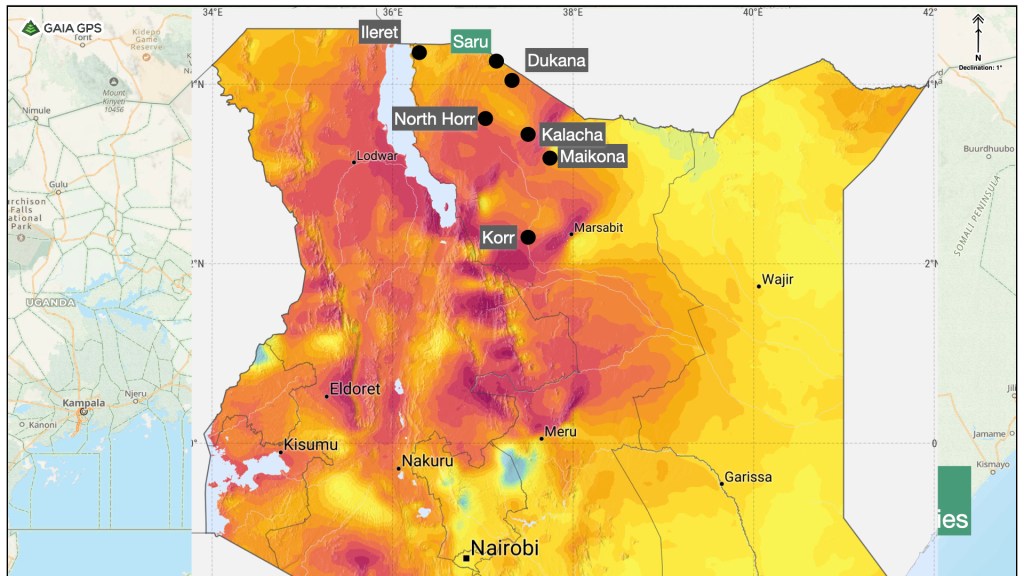
The good news is that these areas have some of the best solar and wind resources on the continent. The bad news is that decades of broken promises from mini-grid companies and political meddling have left communities understandably skeptical.
In Dukana, population 18,000, a private company installed 50kW of solar and built a mini-grid – which is now half-damaged. People started stealing power, the company shut it off, lawsuits followed, the company turned it back on but jacked up the price to $0.64–0.73 per kWh. That’s absurdly expensive. In Ileret, another company installed 24kW of solar that works during the day, but the battery storage failed three years ago and nobody’s come to fix it.
These communities count their wealth in camels and goats. They’re semi-nomadic. They’re intensely political about what gets done and who’s involved. The elder structure matters. Community buy-in isn’t optional.
Why do the economics work now, and didn’t before? Compute as the anchor buyer.
At Gridless, we’ve been using bitcoin mining to monetize stranded hydro, geothermal, and biomass energy for over three years. The model for solar looks the same, except that PV and battery storage costs dropped ~40% in the last year alone, which finally makes solar-plus-compute financially viable.
With compute as the buyer of first and last resort, we can deploy and get solid returns on these projects even if the community never bought a single kilowatt-hour. But because mining only pays roughly $0.10/kWh, the incentives are aligned – the community price just needs to be slightly above that floor. Add a layer of edge AI compute and the margins improve further.
If it works in northern Kenya – with its brutal roads, complex politics, and total absence of grid infrastructure – it’ll work anywhere.
Why this is bigger than Africa

While the Emergent Grid can electrifying remote African communities, and that alone would be worth building, it’s actually a lot bigger than that. It’s about a fundamental rearchitecting of how power and compute relate to each other globally.
Right now, global data center electricity use is headed past 1,000 TWh. Even if only 10% of that load gets sited next to cheap renewables, that’s a $6–8 billion annual power market – and far more in compute-services revenue. The current edge-compute market is $33 billion and growing at 33% annually. Africa’s technical wind potential alone is roughly 250 times its current continental demand. Even tapping 0.1% of that would double today’s global curtailment pool.
The capital is already moving. Data center capex hit $455 billion in 2024 and is forecast to exceed $1 trillion by 2029. The Emergent Grid’s job is to redirect a slice of that spend toward renewable-rich frontiers.
Policy is starting to catch up too. FERC Order 2023 is streamlining interconnection queues. India’s new rules let corporate buyers contract directly for renewables down to 100kW. But approvals for a single high-voltage transmission line still average a decade. Builders can’t wait. So you do what SpaceX did with aerospace bureaucracy: build faster than the forms can travel and export a working precedent.
The invitation
The IEA forecasts that renewables will supply almost half of global electricity by 2030. That statistic means nothing if electrons keep dying in copper bottlenecks while GPUs are throttled for power.
The build spec is straightforward:
- Wire compute to generation.
- Ship infrastructure like code.
- Treat surplus as a feature, not a bug.
- Over-build renewables and let dispatchable compute soak the peaks.
Whether you’re an investor, an engineer, or a policymaker, the invitation is the same. We’ve got more clean electricity than we know what to do with, and more demand for compute than we can satisfy. The Emergent Grid is how those two problems solve each other.
Let’s build.
I did a 10-minute talk on this at the Imagine If conference in Nashville last year: