


Grab your coffee (or tea) and get ready for a long read. I don’t get to write as much as I’d like these days, but Gridless has just turned four, and it feels like the right time to look back at what we set out to build, what we’ve learned, and where we’re going next.
(TLDR; a watt carrying intelligence can earn 15-25x what it earns carrying hashrate, and that changes what we can build in Africa.)
_________________________________
Cost Unknowable, Demand Undefined, Route Unclear
It’s just after sunrise in Nairobi as I write this. The city outside my window exists because, 130 years ago, somebody built a railway that almost nobody believed in.
I like reading old African history books, and I often find the present hiding in them. Technologies change, and problems differ, but human behavior does not. We repeat ourselves, in how we solve hard problems and in how we get swept up in the mania and ambition of the time.
Enormous amounts of capital in the 1800s went to building railways, and each decade produced a new frontier market, from Japan and South Africa to Canada and Argentina. Then finally, in 1896, to deep skepticism and fierce charges of extravagance, came the Lunatic Express. A ribbon of steel running across what would one day be called Kenya.
What it will cost no words can express;
What is its object no brain can suppose;
Where it will start from no one can guess;
Where it is going to nobody knows.
What is the use of it none can conjecture;
What it will carry there’s none can define;
And in spite of George Curzon’s superior lecture,
It clearly is naught but a lunatic line.
This taunt was from Labouchère’s magazine Truth in 1896, as the UK parliament approved 3% of the British Empire’s annual budget to build a railroad through one thousand kilometers of Africa that at the time had no economic activity and virtually no revenue base. It was a brutal build, through hard country and man-eating lions.

Modern Nairobi grew from a supply depot along that railway. The city outside my window is part of the answer to the questions the poem could not answer.
The Lunatic Line was the publicly financed edge of a railway boom driven largely by private capital, at a scale still almost unmatched. At the boom’s height in 1847, Britain was putting an estimated 6.7% of GDP into railway construction. America’s current AI buildout runs at roughly 2%. The comparison is imperfect, but you get the point: this is what a generation betting everything on infrastructure looks like.
Today’s rails are data centers, chips, fiber, and power; the cargo is intelligence. Once again, cost is unknowable, demand undefined and the route unclear. Capital is being laid ahead of demonstrated traffic on the belief that cheap, abundant capacity will summon uses that cannot yet be forecast. This is the wager behind every great infrastructure boom: build the route first, and the economy it makes possible appears along it.
Sometimes it does, but not every line finds enough traffic.
For the last four years, at Gridless we’ve been running a much smaller version of this same bet, on power nobody else wanted.
Four Years at the Edge
At the beginning of Gridless I just wanted to make bitcoin. I had circled bitcoin mining since 2011, flirting with it again in 2014 and 2017 without ever quite taking the leap. After finally doing the research I understood why bitcoin mattered, and it became clear that the way we could put our mark on it was by pairing mining with stranded renewable energy in Africa.
Less than a year into mining, I became preoccupied with a different question: why was so little energy being built on a continent with abundant renewable resources and 600 million people still without electricity?
After reading 17 research papers, the answer became painfully clear. Building rural offgrid power infrastructure is often a bad investment. The rivers and the sunlight are there, and so is the eventual demand, but it just arrives too slowly relative to the capital it takes to build the generation. Spending millions of dollars on an asset that sits two hours down a bumpy dirt road, to serve customers who can afford less than $5 a month, rarely produces an investable return.
Unless… you have a buyer of last resort anchoring your generation. One that can appear quickly, operate almost anywhere, buy every unused watt, and disappear the moment a more important customer needs the power. That is the bitcoin network. It’s both the anchor and the shock absorber.
This realization, that we weren’t just mining bitcoin to produce bitcoin, but that we were mining bitcoin so that communities were electrified, was what took Gridless from being a good story to having a mission that ignited everyone’s imaginations. Because while most people like making money, when you have a mission that puts a positive dent in the world that also makes money, you have something special. A business like that attracts great people and capital, and that mission is what drives you through the hard times of building something new.
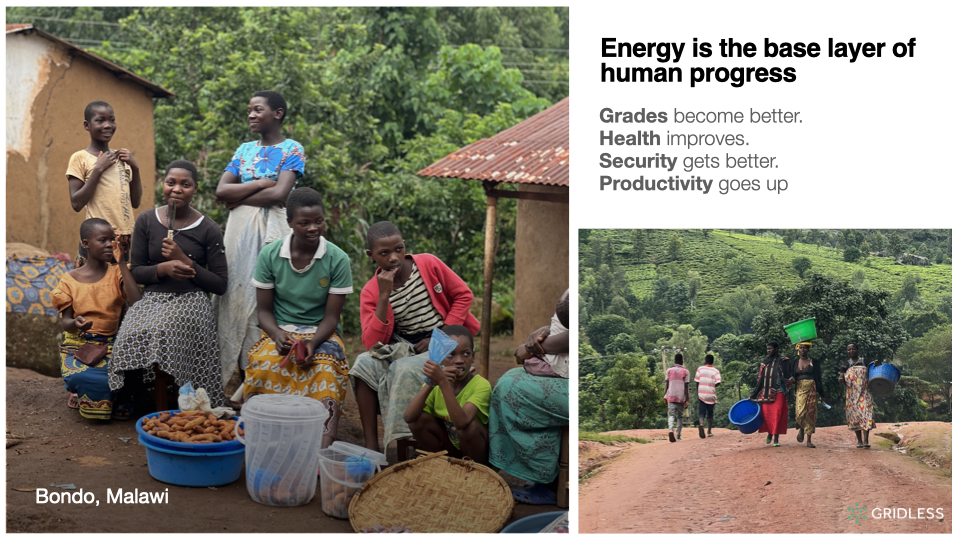
Every week, I ask someone in our team meeting to state that mission: “Gridless uses bitcoin mining to push electrification further to the edges in Africa and help decentralize the bitcoin network.”
Four years later, it works. Six sites in three countries, community power prices cut by a third, 30,000 more people with electricity than when we arrived, and hundreds of new businesses running on that power. Since 2022, we have been demonstrating that flexible digital demand can make off-grid energy in Africa profitable.
What Mining Taught Us
Bitcoin mining taught us an important lesson on commodity compute: as the market matures, margins compress, hardware rapidly depreciates, leaving power as the largest controllable cost. Which means that the companies that survive are the ones with owner economics in the energy itself.
Watching hashprice hit historic lows and navigating four-year halving cycles redefined how we think about Gridless. We began by owning machines that consumed stranded power. We now see our permanent advantage as something much larger: low-cost energy generation, proprietary software that routes power to its highest-value use, and an operating layer that capital partners help finance.
A New Chapter
Africa comes at this from the other end. In the US, the debate is largely about finding enough electricity for compute. Across much of Africa, the more basic challenge is making electricity economical to build at all. The continent holds 18% of the world’s people and less than 1% of its data center capacity. Gridless has spent four years working on that problem, and it turns out the solution leads directly into AI.
We watched the centralized model fail in public this year, in our own market. In May, the billion-dollar Microsoft and G42 data center campus planned for Kenya was shelved. That same month, our sites continued running on rivers, sunshine, and steam that nobody else wanted.
I have been slow to move Gridless into AI, mostly because it is the hot new thing and there are dangers in jumping without knowing what’s in the water. People have asked me to add GPUs since our first year, but I lacked a framework that made sense for us. The machines cost roughly one hundred times more than bitcoin miners, and at first the numbers just didn’t work.
However, a year ago after a conversation with an old friend at one of the big chip companies, I wrote a two-page note that I called “The Emergent Grid.” She sent it further up the chain, and a few weeks later I was surprised to find myself in conversations with people which that little note opened, people specifically thinking about sovereign data requirements around AI.
My thesis was simple: digital offtake drives renewable energy development in Africa, bitcoin is the flexible foundation, GPU compute adds a higher-value layer on top, and intelligence is accessible closer to the people who use it.
This same combination can work anywhere cheap energy is isolated or underutilized, from old oil wells in Texas to abandoned river hydro in Peru, not just on sites in Africa. Our opportunity at Gridless is found in coordinating three layers of demand on the same watt: community comes first, AI creates higher-value revenue, and bitcoin monetizes everything that’s left.
None of this requires Gridless to carry the hardware risk. Capital partners own the GPUs, energy partners own the generation, communities buy the electricity, customers buy the compute, and bitcoin buys whatever is left. We run the system. The expensive, fast-depreciating machines don’t sit on our balance sheet.
So we started modeling what could be done with GPUs, not just ASICs. The result is a framework that doesn’t remove miners and replace them with AI. Instead, the miners are our buyer of first resort on every new watt, and the shock absorber for a system with intermittent renewable supply and variable community demand. (And, much like shock absorbers on your car, you don’t really pay attention to them until they’re not there.)
The Dispatch Stack
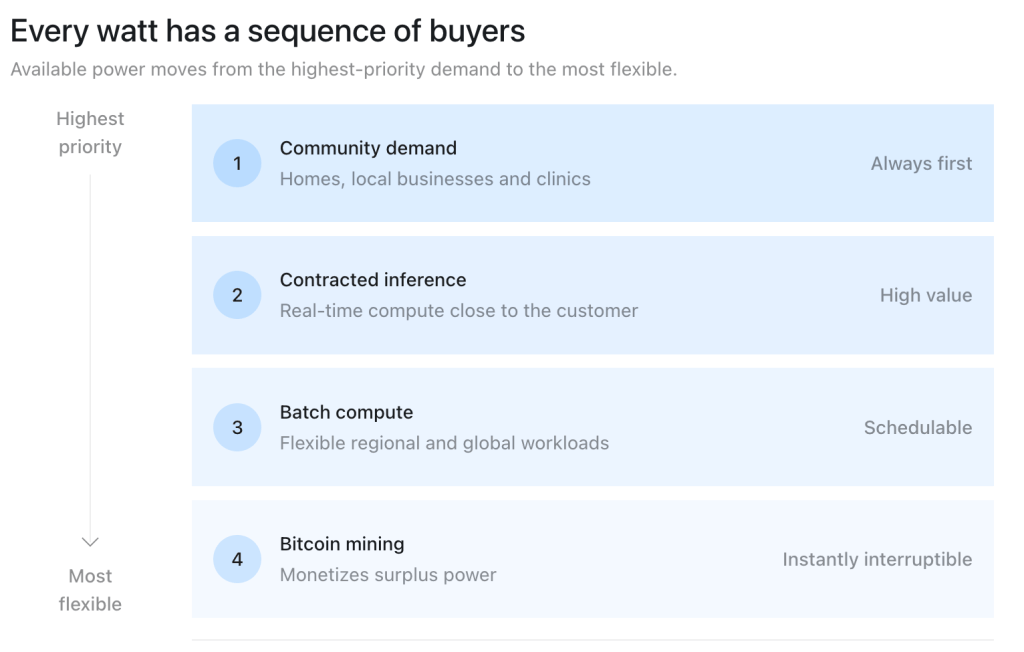
The insight is to give every available watt a sequence of buyers, ordered by value and priority. Gridless OS, the software layer that already runs our sites, is gaining an AI dispatch layer that builds on our existing community-first controls and routes each watt down a value ladder:
- Community First: for homes, local businesses, clinics, and schools.
- Contracted Inference: high-value, real-time local compute.
- Batch Compute: flexible background workloads for global customers.
- Bitcoin Mining: the revenue floor (an always-on bid that monetizes curtailment, so no watt is wasted).
Bitcoin’s role changes as the higher-value demand grows, but it isn’t replaced. It makes the initial generation viable, absorbs the variability in the system, and gives every new watt a buyer while community and compute demand develop. It’s the hedge under the whole system: an always-on, dollar-paying bid for any watt with no better customer yet. That’s the emergent grid: a system for routing energy to its best available use, rather than just an electricity project or a mining operation.
This is also where the hard software problem lives. A standard microgrid controller keeps a system stable by shedding load when it must. Gridless OS goes further and sells that load. It arbitrates in real time between an interruptible buyer that can vanish in milliseconds (mining), SLA-bound workloads that can’t be interrupted at all (inference), batteries that need protecting, and a community whose demand always comes first. Four years of operating data from African minigrids is baked into how it makes those calls. It’s not something you easily buy off the shelf, or vibe code over the weekend.
An AI container at roughly 4% utilization generates the same site-level revenue as an equivalently powered bitcoin container operating continuously. Put another way, GPU compute generates 15-25x what bitcoin does per kWh. That doesn’t mean GPU economics are automatically superior, as the equipment is far more expensive and depreciates quickly, but it does mean that when partners finance the equipment, we can add a much higher-value demand layer while bitcoin continues to monetize the unused power.
A Constellation, not a Hyperscaler
Out of this grows Gridless AI, a way of looking at AI inference through an African lens. We won’t soon see gigawatt data centers here; for context, peak demand in all of Kenya is 2.5GW on a 3.5GW supply.
Instead, Africa’s AI demand can be met with a constellation of small and medium sized nodes. A future where off-grid renewable sites host compute nodes that operate as spokes to medium-sized, fiber-connected regional hubs.
In that architecture, a small hydro plant, geothermal resource or solar installation is no longer only an electricity project. It can become part of a distributed productive-compute network. The workloads might include a clinic’s triage system, a bank’s fraud checks, crop diagnostics delivered to a farmer’s phone, government workloads that aren’t allowed to leave the country, or flexible overnight batch jobs from customers an ocean away.
Not every workload belongs at the edge. Training frontier models needs immense clusters, reliable connectivity, and a scale these sites won’t provide. But inference, sovereign workloads and interruptible batch jobs are different. They can be distributed, scheduled, and placed closer to cheap power or to the people using them.
The hardware matches the job. Edge nodes run smaller, air-cooled inference GPUs rather than the liquid-cooled clusters built for training, housed in the same kind of modular containers our miners taught us to deploy fast. Hubs sit on fiber; edge sites pair terrestrial links with satellite backup. Latency, heat and uptime are exactly what our first deployments are instrumented to measure.
Our part is the sites, the relationships, the energy integration, the orchestration software, and the operating capability that makes the whole system work.
Finding a Sane Line
Unlike the railway builders, we don’t have to lay the whole line before knowing whether it works. We can build it one deployment at a time.
We’ll start with a small solar site in the Congo and a hydro site in Kenya, followed by showcase racks in Nairobi and a geothermal hub. Each deployment will cost between $500,000 and $6 million, be financed separately and stand on its own results. No single site has to carry the proof of the entire thesis.
The purpose is unchanged: to push electrification further into Africa while making intelligence cheaper and decentralizing the bitcoin network. If the model works, it can spread one site at a time to places where power is abundant but conventional demand is not.
We know what the first sites will carry: electricity, intelligence and hashrate.
Four Years In
The sun is fully up over Nairobi now, the railway’s old supply stop. Labouchère’s poem ended up as a historical footnote, and the railway ended up shaping a country.
The questions are now practical rather than poetic. Our current work is about proving that these units can run reliably at our sites, and that blended AI-and-bitcoin dispatch improves the economics. We also need recurring compute customers and proof that our connectivity, cooling and orchestration can support real workloads.
Four years into Gridless, we’re still making a wager on infrastructure built ahead of obvious demand. But ours is not a wager that requires demand to arrive all at once. Our line can pay its way from the first mile, because bitcoin buys the residual capacity while community and AI compute demand grow into it.
- If you need inference or batch capacity in Africa, the first offtake conversations are underway and we’d like to talk.
- If you build or finance GPU capacity and want it sited on some of the cheapest clean power in the world, we have the sites and the operating layer.
- If you own generation with unsold power, we can give every watt a buyer from day one.
The line is getting built either way. Come build it with us.